
If you run a tier-one telematics service or manage a specialized commercial fleet, you have likely sat through a dozen presentations about “AI-powered video telematics.” You might even have run a pilot project with a few connected dashcams.
Yet, when you look at the industry at large, a frustrating reality emerges: most fleet operators are stuck in an infinite loop of pilot programs, or they are using advanced hardware to do nothing more than record basic event clips.
The bottleneck isn’t a lack of interest or budget. The bottleneck is structural. The current crop of video telematics solutions remains fundamentally trapped by an old industry standard: the G-force trigger.
To scale video telematics into something that actually changes fleet operational margins, we have to move past primitive sensor triggers and address the engineering constraints of data transfer, edge compute, and true situational context.
The flaw in the G-Force trigger
Traditional video telematics systems are reactive. They rely on an inertial measurement unit (IMU) to detect an abrupt shift in physics—a hard braking event, a sharp turn, or a sudden impact. When the G-force exceeds a pre-set threshold, the camera wakes up, clips the last 10 seconds of video, and pushes it up to the cloud.
This framework introduces two massive operational failures:
- False positives: A delivery truck hitting a deep pothole on a city street generates the exact same G-force spike as a near-collision. The system flags it as aggressive driving. The fleet manager gets an alert, a human analyst has to manually review the video, and the driver gets penalized for road conditions they didn’t create.
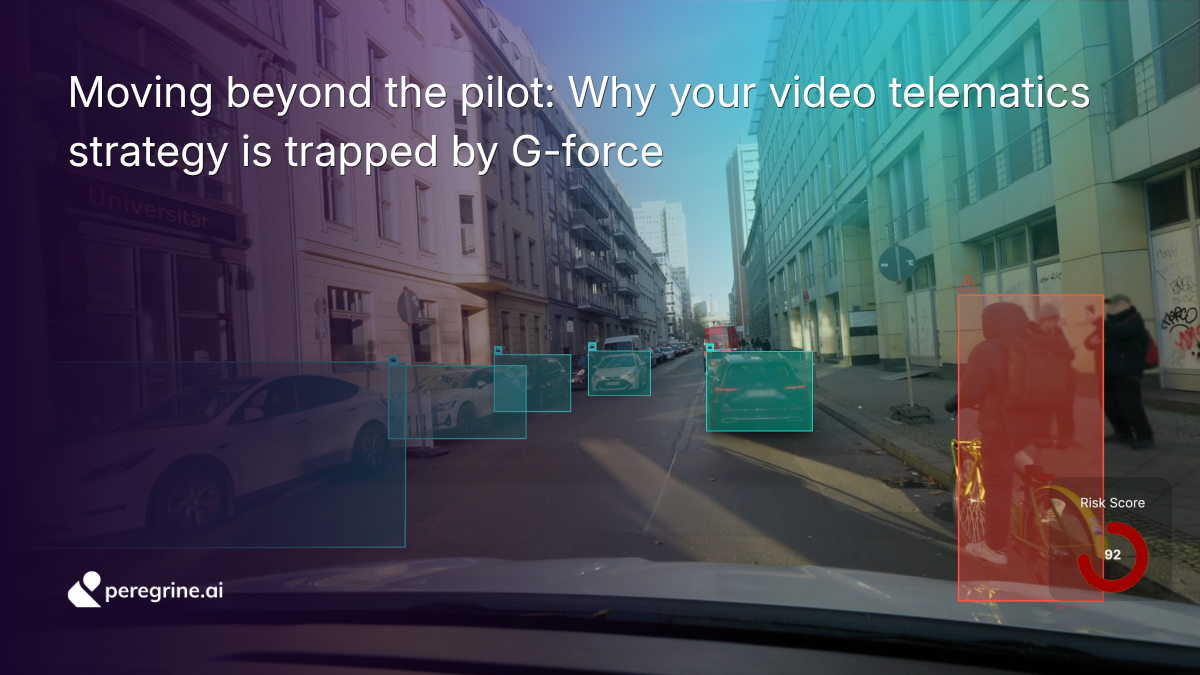
- Invisible high-risk drivers: Imagine a driver tailgating a passenger car at 80 km/h in dense fog, or weaving through a highly active urban construction zone surrounded by cyclists. If that driver is smooth with their feet and hands, they will never trigger an IMU. To your current dashboard, they look like an exemplary driver. In reality, they are a rolling liability asset. This is why true situational awareness requires software explicitly designed to decode complex road environments.
The problem is a complete lack of visual context. An acceleration spike or a hard brake is a symptom, not the cause. To assess risk accurately, your software needs to understand why an action occurred. Did the driver brake hard because they were distracted, or because a vulnerable road user stepped out from behind a parked van?
The engineering reality: Why you can’t just “cloud It away”
The lazy answer to the context problem is to stream everything to the cloud and let a centralized server sort it out.
But anyone who has managed localized field deployments knows the math doesn’t work. The average commercial vehicle in a urban logistics environment covers about 150 kilometers a day. If you scale that across a fleet of 500 vehicles, streaming continuous raw video over LTE or 5G generates astronomical data bills that instantly erase the ROI of your telematics pipeline.
Furthermore, cloud processing introduces a critical latency gap. If your AI takes three to five seconds to ingest video, run inference on a remote server, and flag a tailgating event, the window for active risk mitigation has already closed. The insight is historical, not actionable.
The solution: Multi-head edge architectures
To build video telematics that actually add value, the vehicle must act as an independent, intelligent node. It has to process, understand, and filter the environment locally on the edge, without cloud reliance.
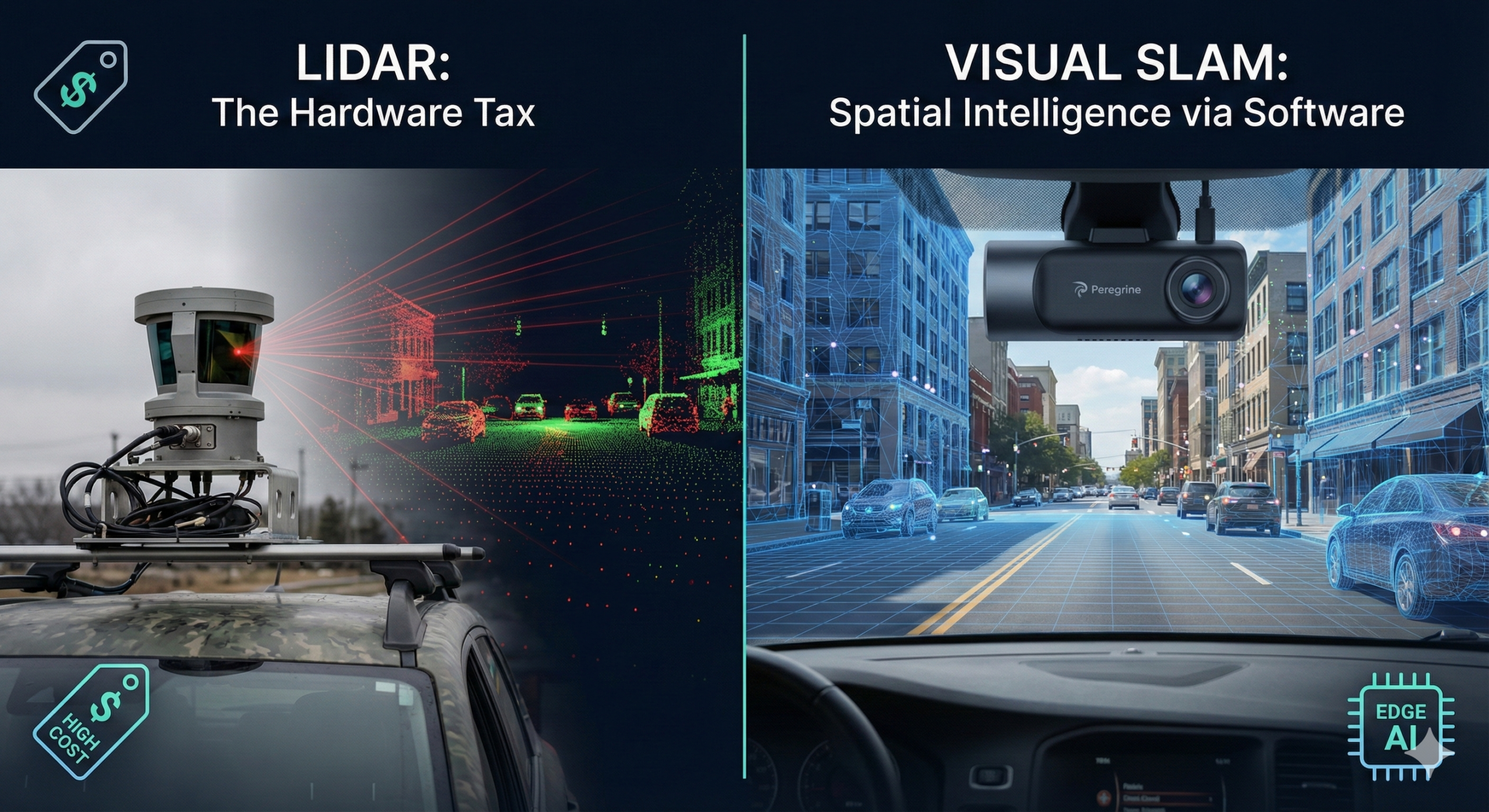
This requires moving away from heavy, standalone computer vision models. Running three separate single-task models on a dashcam—one for lane geometry, one for object tracking, and one for road conditions—will quickly overheat standard, consumer-grade processors like Qualcomm Snapdragon chipsets.
At Peregrine, we solved this by engineering a proprietary Multi-Head Neural Network. Developed and stress-tested through the ongoing R&D at Peregrine Labs, this approach cuts required compute resources
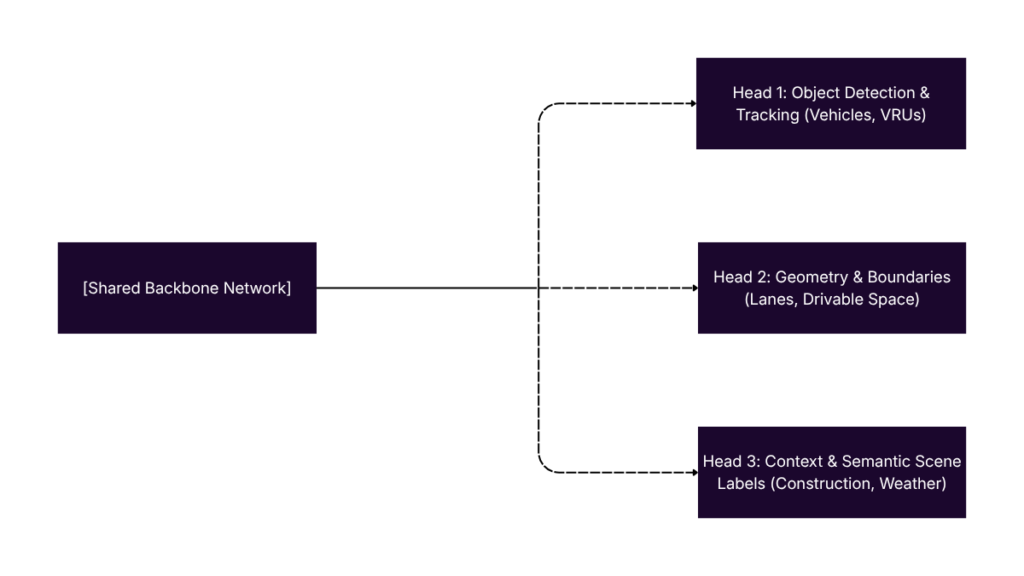
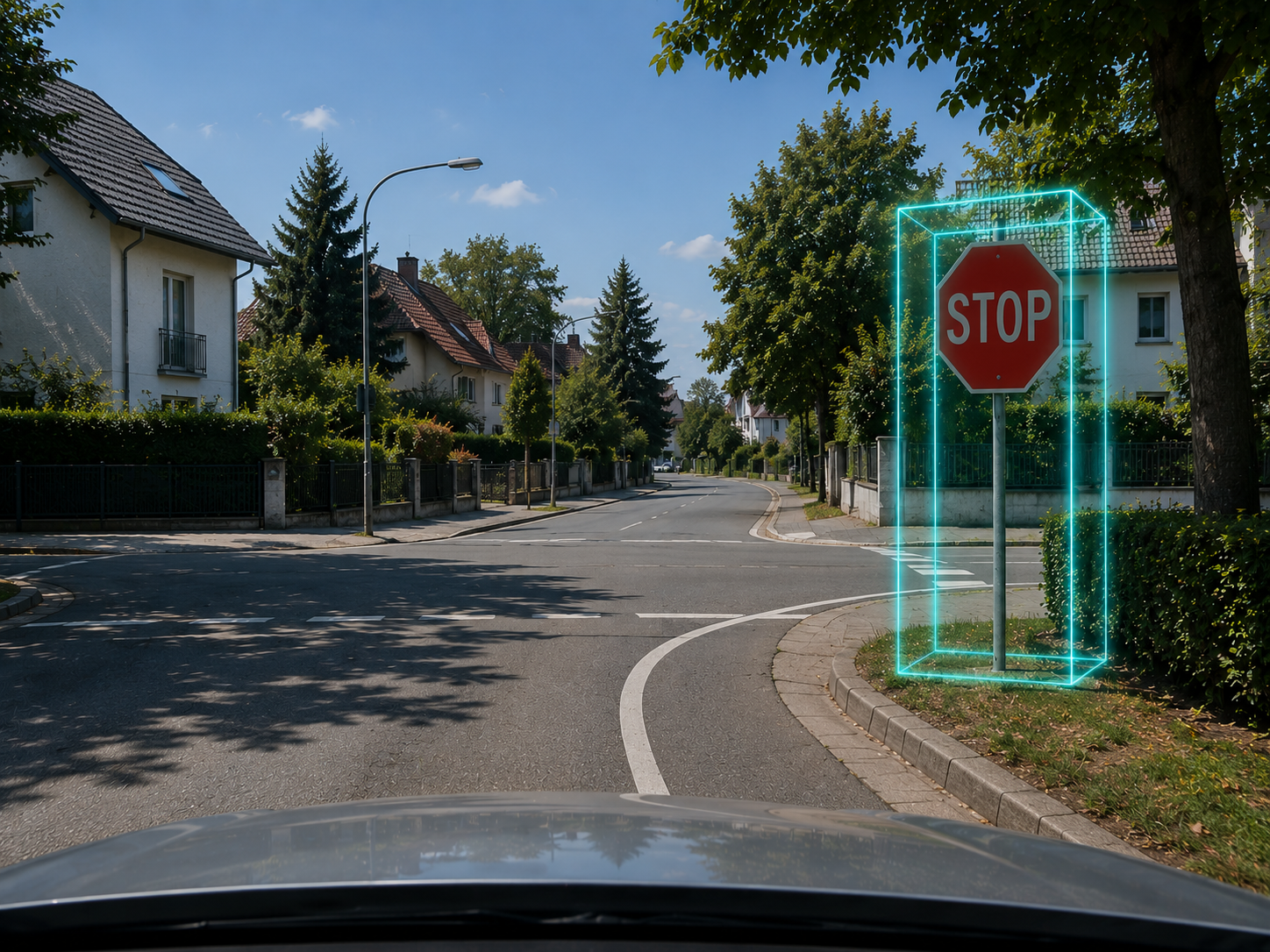
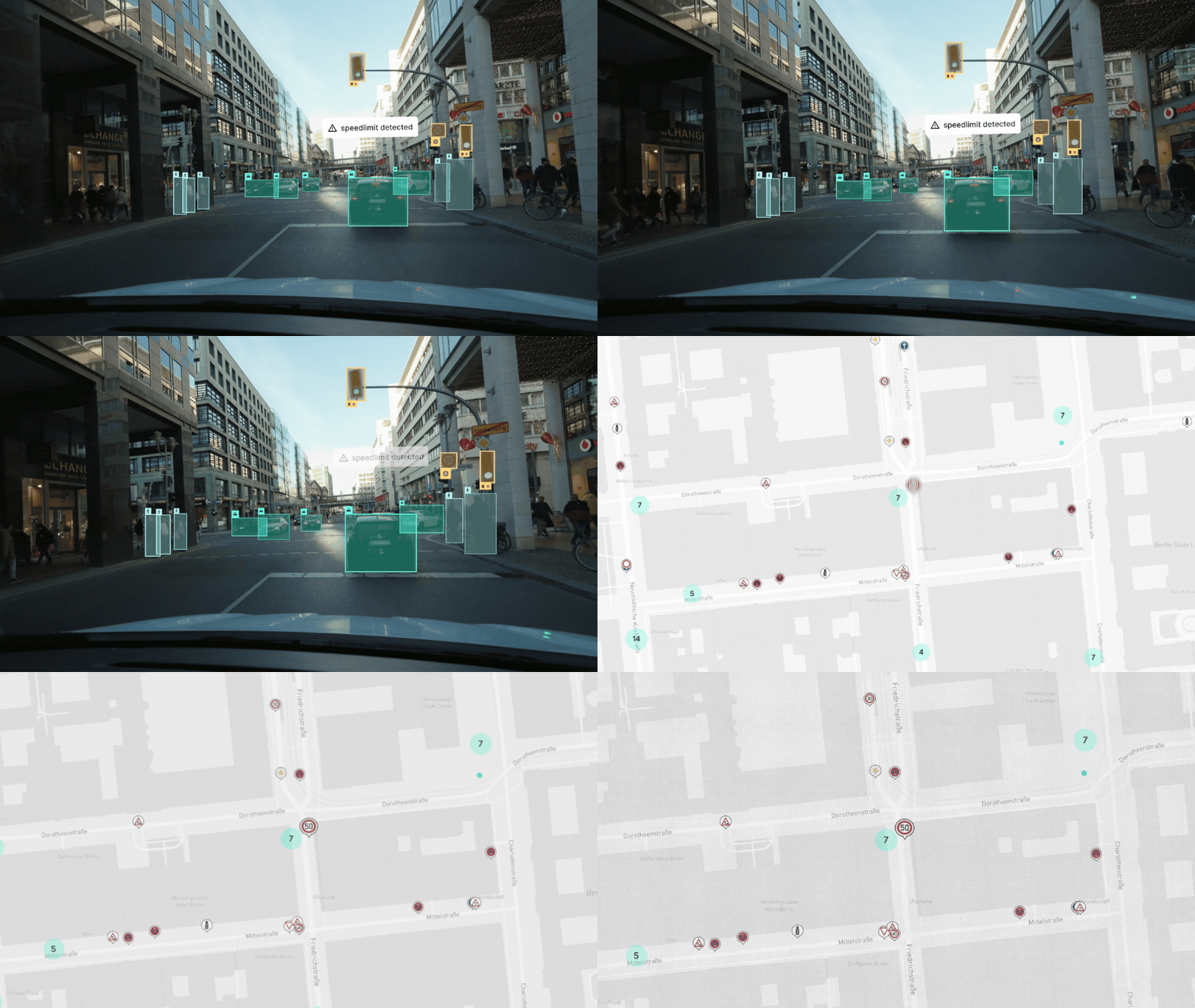
Instead of running redundant pipelines, a single, highly optimized neural network backbone handles the core image feature extraction locally on the device. From that shared base, specialized processing heads run lightweight inference simultaneously to track objects, read lane geometry, map road signs, and calculate time-to-collision (TTC).
This approach cuts required compute resources by roughly 3x compared to independent models. More importantly, it allows us to drop the data volume by over 99% at the edge. The system discards the 99% of uneventful driving video and uploads only the precise metadata and localized visual context points that hold operational value.
Watch how our Multi-Head Neural Network tracks real-time scene complexity, close collisions, and traffic violations simultaneously on standard hardware in our Perception Features Gallery
Real contextual risk scoring
When your edge software can synthesize variables like traffic density, weather conditions, and proximity to vulnerable road users in real-time, your fleet metrics change entirely.
Instead of a generic risk score based on how many times a driver stepped hard on the brakes, you unlock condition-aware evaluation. You can reward drivers who navigate highly complex, high-pressure urban environments cleanly, while identifying the smooth but dangerous operators who actively create near-miss scenarios.
The future of video telematics isn’t about capturing more video clips. It is about converting a massive, expensive stream of visual noise into a clean, structured, and highly searchable dataset right where it happens: at the edge. That is how we move past the pilot phase and start running intelligent operations.