Steffen Heinrich

three layers of a video telematics product: camera hardware, perception software and the provider's own product.

Build or buy computer vision for dashcams? A guide for telematics providers

By Steffen Heinrich · Last updated 27 October 2026 For most telematics service providers, licensing perception software from a specialist partner and building their own product layer on top is faster and lower-risk than developing dashcam computer vision in-house. Building pays off when perception is your core differentiator, you control a single camera platform, and

Build or buy computer vision for dashcams? A guide for telematics providers Read More »

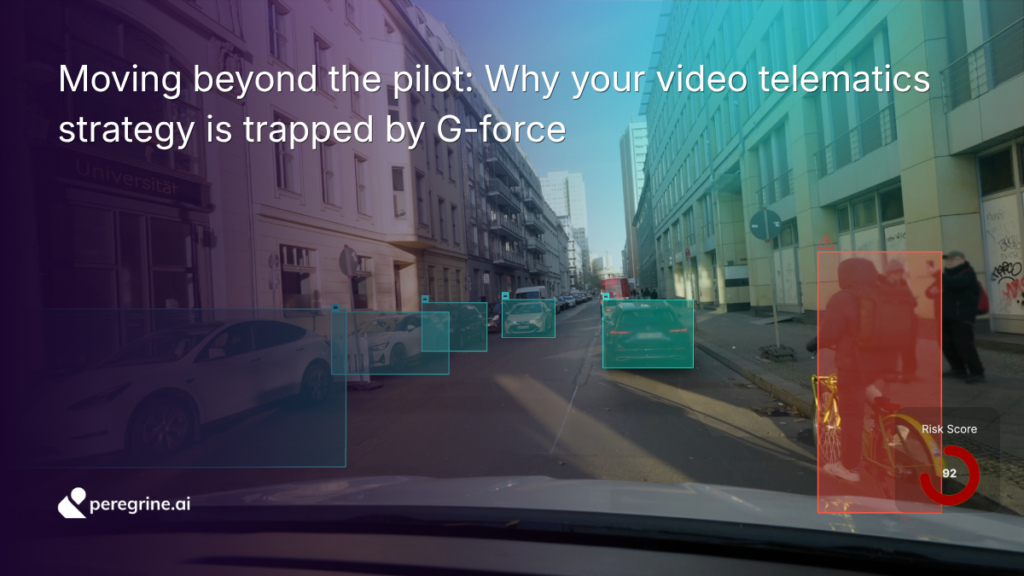
A dashcam view of a city street with complex Peregrine.ai technology overlays. Blue boxes detect multiple cars, and a distinct red box highlights a cyclist with a high 92% risk score circular overlay. Large text across the top discusses moving beyond the pilot in video telematics strategy and moving beyond G-force.

Moving beyond the pilot: Why your video telematics strategy is trapped by G-force

If you run a tier-one telematics service or manage a specialized commercial fleet, you have likely sat through a dozen presentations about “AI-powered video telematics.” You might even have run a pilot project with a few connected dashcams. Yet, when you look at the industry at large, a frustrating reality emerges: most fleet operators are

Moving beyond the pilot: Why your video telematics strategy is trapped by G-force Read More »

The Rise of DaaS in Telematics: How Fleets Are Monetizing Video Data with Visual SLAM

Last updated: 4 November 2026 Telematics providers can earn from camera data in two ways: a paid AI upgrade for video telematics, and anonymized road and infrastructure data for cities, map providers and AV developers. Peregrine.ai, an edge AI company for mobility in Berlin, supplies the perception software and the Peregrine Data layers behind both

The Rise of DaaS in Telematics: How Fleets Are Monetizing Video Data with Visual SLAM Read More »

Comparison of expensive LiDAR hardware versus Peregrine Visual SLAM software on a standard camera. We are living through a pivotal moment in machine perception. For the last decade, the prevailing wisdom in autonomous driving and advanced robotics was simple: if you want a machine to truly understand the 3D world around it, you need LiDAR.

Visual SLAM vs. LiDAR: Achieving Spatial Intelligence Without the Hardware Tax

We’ve all seen the prototype vehicles outfitted with spinning laser arrays on their roofs. They are engineering marvels, spinning tens of thousands of dollars’ worth of delicate hardware to generate precise, dense point clouds of their environment. In a controlled R&D setting with unlimited budgets, LiDAR is spectacular. But the real world doesn’t operate on

Visual SLAM vs. LiDAR: Achieving Spatial Intelligence Without the Hardware Tax Read More »

A group of Peregrine Technologies team members, partners from T-Systems, and local stakeholders stand together near a dynamic speed limit sign displaying '30' in a school zone in Landshut, Germany. The group is gathered on a sidewalk, surrounded by autumn trees and buildings, marking the successful launch of the 5-SAFE AI-powered traffic safety system to enhance school zone safety.

Peregrine.ai and Partners Unveil 5-SAFE: An Advanced AI-Driven Traffic Safety System for Landshut’s School Zones

Landshut, Germany – [November 2024] – Peregrine.ai, a pioneering force in AI-powered vision solutions, has deployed its state-of-the-art 5-SAFE system to revolutionize traffic safety in school zones. Designed and developed in collaboration with T-Systems, Landshut University of Applied Science, and the City of Landshut, and backed by Germany’s 5G Initiative and the Federal Ministry for

Peregrine.ai and Partners Unveil 5-SAFE: An Advanced AI-Driven Traffic Safety System for Landshut’s School Zones Read More »

AI at the Edge Transforms Fleet Safety Technology with Video Telematics

Fleet Safety Technology: AD Technology on Fleet Dashcams

In today’s dynamic world, fleet safety technology is a critical concern for fleet managers and drivers alike. Our innovative software solution elevates outward facing fleet dashcams beyond just recording devices, transforming them into intelligent systems capable of understanding and interpreting the road. Leveraging environmental perception, computer vision, and data fusion with Inertial Measurement Units (IMUs),

Fleet Safety Technology: AD Technology on Fleet Dashcams Read More »

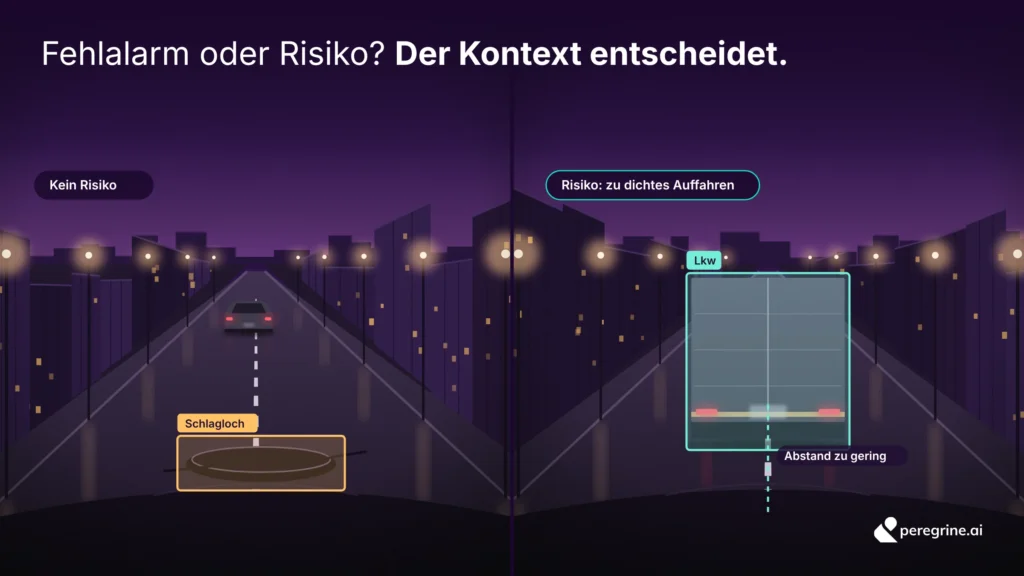
AI contextual awareness for fleet dashcams to understand scene complexity and reduce false positives.

Vision-Based Safety: Reducing False Positives Generated by Fleet Dashcams with Cloud AI

In our last blog post, we delved into the transformative benefits of leveraging AI at the edge, exploring how it brings intelligence closer to devices and processes. Building on that discussion, we now turn our attention to another dimension of technological innovation: the integration of cloud computing in tandem with fleet dashcams and Computer Vision

Vision-Based Safety: Reducing False Positives Generated by Fleet Dashcams with Cloud AI Read More »

AI at the Edge Transforms Fleet Safety Technology with Video Telematics

Vision-Based Safety: AI at the Edge in Video Telematics

In the fast-evolving world of fleet management, video telematics has emerged as a game-changer. This cutting-edge technology combines video data and vehicle telemetry to offer comprehensive insights into fleet operations. As we navigate through the details of this technology, it’s crucial to weigh its advantages against its concerns. Let’s investigate how AI at the edge

Vision-Based Safety: AI at the Edge in Video Telematics Read More »